How to find your boat's hull number (HIN)
Your hull identification number, or HIN, is your boat's own serial number. It's marked on the hull when the boat is built, and it stays with the boat if it's sold or renamed. Insurers, the police and buyers all ask for it, so it's worth knowing where yours is before you need it.
Where to look
- On the back of the boat. Look on the right-hand side as you face forward (the starboard side) of the transom, the flat panel at the stern. It's usually near the top edge, just below the gunwale or the join between hull and deck.
- On a RIB. Check the rigid hull at the stern first, not the inflatable tubes. Some builders fit a small plate to the tube beside the transom, so look there too.
- A second copy. Many boats also carry a second copy somewhere out of sight inside the hull, so the number can still be traced if the outside one is damaged or removed. Your builder or dealer can tell you where it is.
- In your paperwork. Check the bill of sale, the builder's declaration of conformity or the owner's manual, and your insurance schedule.
What it looks like
Boats built for sale in Europe from 1998 should carry a 14-character number. It's often written with hyphens, like this invented example:
GB-EXM00123-E9-20
- GB is the country of the builder.
- EXM is the builder's own code.
- 00123 is the boat's serial number.
- E9 is the month and year it was built. The letter runs from A for January to L for December, so E is May. The digit is the last digit of the year, so 9 is 2019.
- 20 is the model year.
Older boats and boats built outside Europe may have a shorter number, often 12 characters, or none at all.
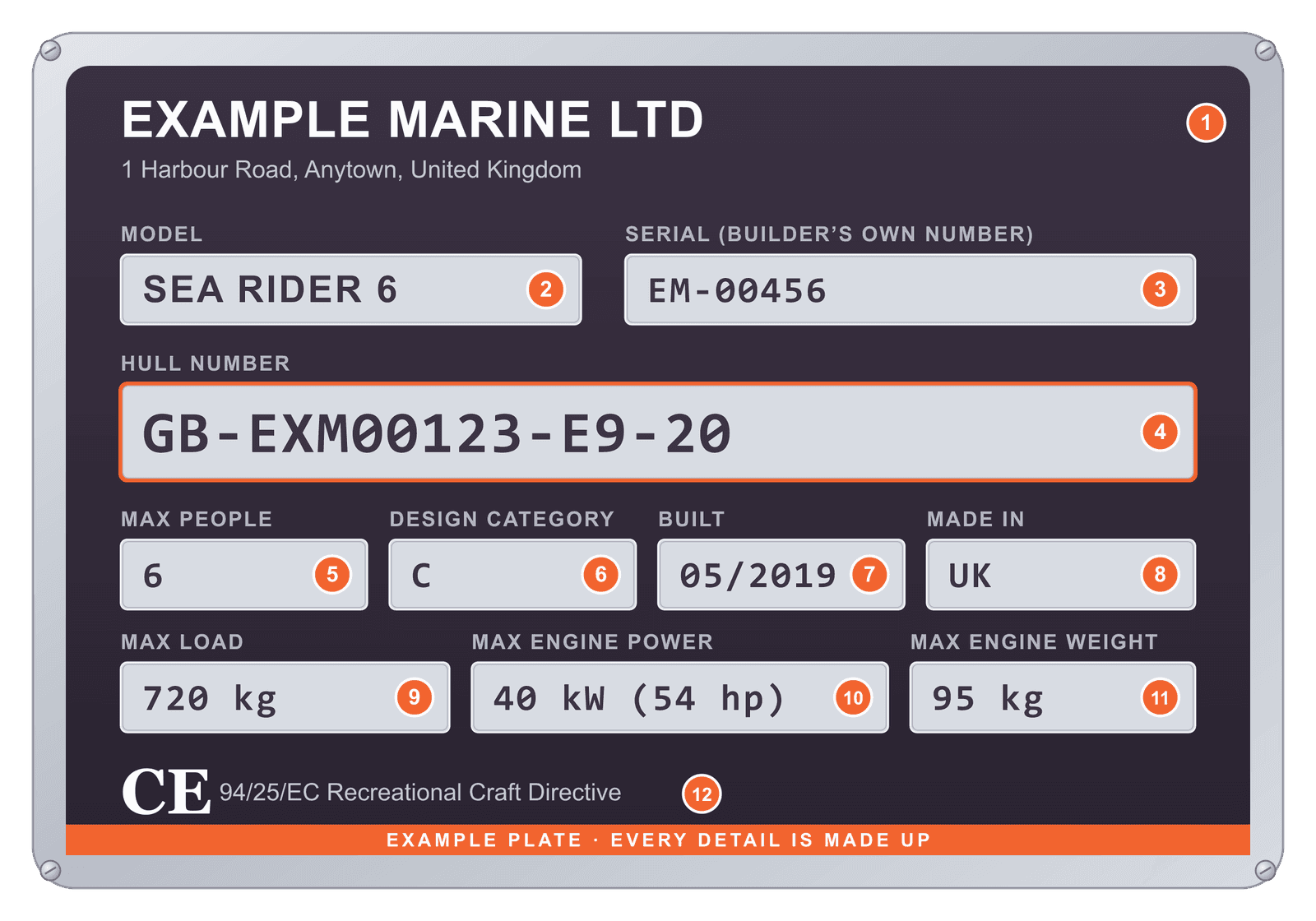
An example plate with made-up details. On many plates the hull number has its own box (marker 4), but on plenty of boats it's marked on the hull instead.
Don't mix it up with the builder's serial
A builder's plate often shows a “serial” as well. That's the builder's own reference for the boat, and it may not be the same as the hull number. Look for both, and write both down. Our guide to reading your boat's builder's plate shows the difference.
Tips for reading it
- Take a photo with a torch held at an angle across the marking. The shadows make stamped or moulded characters easier to read.
- Don't confuse it with your engine serial number, your trailer chassis number or sail number. They're different numbers.
- Photograph it now and keep the picture somewhere safe.
If you can't find it
- Look beyond the top of the transom. Some builders mark the number elsewhere, including on the outside of the hull or lower down the stern. One BoatID owner found theirs on the side of the hull.
- Check any plates, but read them carefully. The number on a builder's plate may be the builder's serial, not the hull number.
- Ask the builder, or the dealer who sold the boat. They often keep a record by serial number.
- Check the whole stern, including under fittings and behind brackets.
- If the boat is older, a builder's own number may be the best you have.
Still stuck? Get in touch and we'll help you work out what to do.
Keep it with your other details
BoatID is a free place for UK owners of sea boats up to 10 metres to keep their boat, engine and trailer details and photos together. Every entry is checked by a person.
Own a boat, engine or trailer?
Give it a BoatID of its own. It's free and takes about five minutes.
Register yours — freeBuying a boat? Check a BoatID number or hull number.