How to read your boat's builder's plate
Most boats built for sale in Europe carry a small metal plate from the builder. It's called the builder's plate, the compliance plate or the CE plate. Some people search for a “boat registration plate”, but it isn't a registration. It's the builder's own statement of what the boat is and what it's built to do.
It packs a lot of useful information into a small space. Here's what each part means.
Where to find it
It varies from boat to boat. Look on the transom, the console or near the helm, and on a RIB check the rigid hull as well as the console. It's often partly hidden behind cables or fittings.
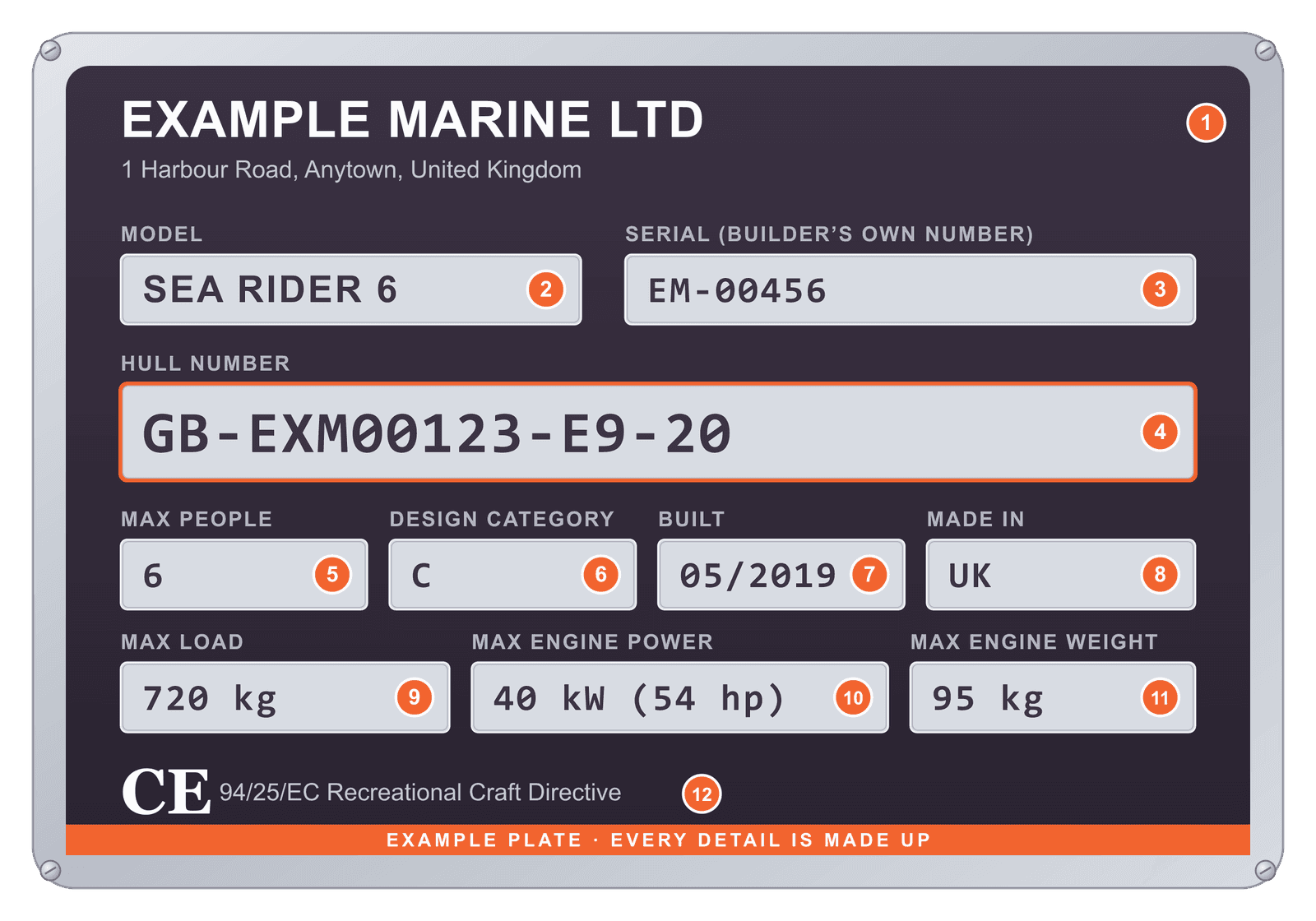
An example plate with made-up details. Real plates differ in layout and wording.
What each part means
Builder and address. Who built the boat. If the company has since changed its name or been taken over, the details still help trace the boat.
Model. The builder's name for this boat.
Serial. The builder's own number for this boat. It is often not the same as the hull number, so record both.
Hull number. The 14-character number described in our hull number guide. Not every plate shows it. On many boats it's marked on the hull instead.
Maximum people. The most people the boat is designed to carry.
Design category. The sea conditions the boat is designed for. A is ocean, B is offshore, C is inshore and D is sheltered waters.
Built. The month and year the boat was built. The layout varies, so you may see 05/2019 or 0519.
Made in. Where the boat was built.
Maximum load. The most the boat should carry in total: people, engine, fuel and gear together.
Maximum engine power. The biggest engine the builder recommends, in kilowatts and often horsepower too.
Maximum engine weight. The heaviest engine the boat is designed to carry. Not every plate shows it.
CE mark and directive. The boat was built to Europe's rules for recreational craft. Older plates may show the directive as 94/25/EC, or 94/25/CE in French style. Newer boats may cite a later version, and UK-built boats may show a UKCA mark instead.
The limits are there for a reason
The maximum people, load and engine figures are the builder's safety limits for the boat. Staying inside them matters for how the boat handles, and for your insurance.
What to do with it
- Photograph the whole plate in good light, and keep the picture somewhere safe.
- Write down the model and serial, and the hull number too if it's a separate one.
- Remember a plate can be removed or replaced. The hull number is marked into the boat itself, so it's the stronger identifier.
- If your plate shows a serial but no hull number, see our guide to finding your hull number.
Keep it with your other details
BoatID is a free place for UK owners of sea boats up to 10 metres to keep their boat, engine and trailer details and photos together, including a photo of the plate. Every entry is checked by a person.
Own a boat, engine or trailer?
Give it a BoatID of its own. It's free and takes about five minutes.
Register yours — free